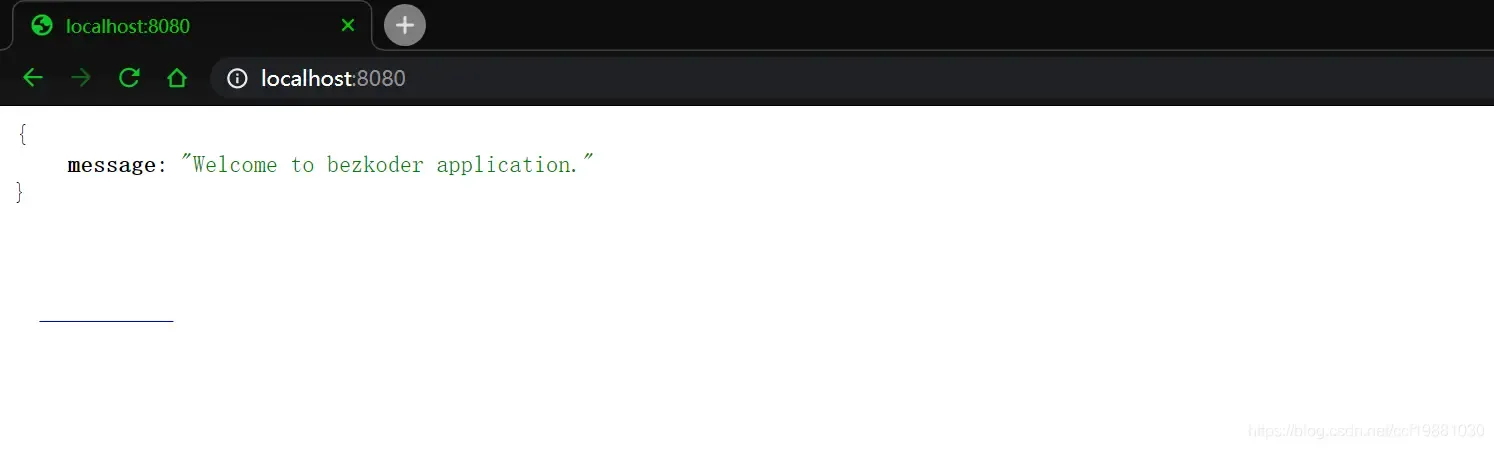
http://localhost:8080
是的,第一步已经完成。 在下一节中,我们将与Sequelize一起协作。
配置MySQL数据库并进行序列化
在app文件夹中,我们创建一个单独的config文件夹,然后使用db.config.js文件进行配置,如下所示:
module.exports = {
  HOST: "localhost",
  USER: "root",
  PASSWORD: "123456",
  DB: "testdb",
  dialect: "mysql",
  pool: {
    max: 5,
    min: 0,
    acquire: 30000,
    idle: 10000
  }
};
前面5个参数用于MySQL连接。
pool是可选的,它将用于Sequelize连接池配置:
- max:池中的最大连接数
- min:池中的最小连接数
- idle:连接释放之前可以空闲的最长时间(以毫秒为单位)
- acquire:该池将在抛出错误之前尝试获取连接的最长时间(以毫秒为单位)
有关更多详细信息,请访问API Reference for the Sequelize constructor。
初始化Sequelize
我们将在下一步包含模型的app/models文件夹中初始化Sequelize。
现在,使用以下代码创建app/models/index.js:
const dbConfig = require("../config/db.config.js");

const Sequelize = require("sequelize");
const sequelize = new Sequelize(dbConfig.DB, dbConfig.USER, dbConfig.PASSWORD, {
  host: dbConfig.HOST,
  dialect: dbConfig.dialect,
  operatorsAliases: false,

  pool: {
    max: dbConfig.pool.max,
    min: dbConfig.pool.min,
    acquire: dbConfig.pool.acquire,
    idle: dbConfig.pool.idle
  }
});

const db = {};

db.Sequelize = Sequelize;
db.sequelize = sequelize;

db.tutorials = require("./tutorial.model.js")(sequelize, Sequelize);

module.exports = db;
不要忘记在server.js中调用sync()方法
...
const app = express();
app.use(...);

const db = require("./app/models");
db.sequelize.sync();

...
在开发中,您可能需要删除现有表并重新同步数据库。 只需使用force:true即可,如下代码:
db.sequelize.sync({ force: true }).then(() => {
  console.log("Drop and re-sync db.");
});
定义Sequelize模型
在models文件夹中,像这样创建tutorial.model.js文件:
module.exports = (sequelize, Sequelize) => {
  const Tutorial = sequelize.define("tutorial", {
    title: {
      type: Sequelize.STRING
    },
    description: {
      type: Sequelize.STRING
    },
    published: {
      type: Sequelize.BOOLEAN
    }
  });

  return Tutorial;
};
该Sequelize模型表示MySQL数据库中的tutorials表。 这些列将自动生成:id, title, description, published, createdAt, updatedAt.
初始化Sequelize之后,我们无需编写CRUD函数,Sequelize支持所有这些功能:
- 创建一个新的教程:create(object)
- 通过id查找教程:findByPk(id)
- 获取所有教程:findAll()
- 通过id:update(data, where: { id: id })
- 删除教程:destroy(where: { id: id })
- 删除所有教程:destroy(where:{})
- 按标题查找所有教程:findAll({ where: { title: … } })
这些功能将在我们的控制器中使用。
我们可以通过为每个教程添加评论来改进示例。 这是一对多关系,我为此编写了一个教程:
Sequelize Associations: One-to-Many example – Node.js, MySQL
或者,您可以为每个教程添加标签,并将教程添加到标签(多对多关系):
Sequelize Many-to-Many Association example with Node.js & MySQL
创建控制器
在app/controllers文件夹中,让我们使用以下CRUD函数创建tutorial.controller.js:
- create
- findAll
- findOne
- update
- delete
- deleteAll
- findAllPublised
const db = require("../models");
const Tutorial = db.tutorials;
const Op = db.Sequelize.Op;

// Create and Save a new Tutorial
exports.create = (req, res) => {

};

// Retrieve all Tutorials from the database.
exports.findAll = (req, res) => {

};

// Find a single Tutorial with an id
exports.findOne = (req, res) => {

};

// Update a Tutorial by the id in the request
exports.update = (req, res) => {

};

// Delete a Tutorial with the specified id in the request
exports.delete = (req, res) => {

};

// Delete all Tutorials from the database.
exports.deleteAll = (req, res) => {

};

// Find all published Tutorials
exports.findAllPublished = (req, res) => {

};
让我们实现这些功能。
创建一个新对象
创建并保存一个新教程:
exports.create = (req, res) => {
  // Validate request
  if (!req.body.title) {
    res.status(400).send({
      message: "Content can not be empty!"
    });
    return;
  }

  // Create a Tutorial
  const tutorial = {
    title: req.body.title,
    description: req.body.description,
    published: req.body.published ? req.body.published : false
  };

  // Save Tutorial in the database
  Tutorial.create(tutorial)
    .then(data => {
      res.send(data);
    })
    .catch(err => {
      res.status(500).send({
        message:
          err.message || "Some error occurred while creating the Tutorial."
      });
    });
};
检索对象(有条件)
从数据库中检索所有教程/按标题查找:
exports.findAll = (req, res) => {
  const title = req.query.title;
  var condition = title ? { title: { [Op.like]: `%${title}%` } } : null;

  Tutorial.findAll({ where: condition })
    .then(data => {
      res.send(data);
    })
    .catch(err => {
      res.status(500).send({
        message:
          err.message || "Some error occurred while retrieving tutorials."
      });
    });
};
我们使用req.query.title从Request中获取查询字符串,并将其作为findAll()方法的条件。
检索单个对象
查找具有ID的单个教程:
exports.findOne = (req, res) => {
  const id = req.params.id;

  Tutorial.findByPk(id)
    .then(data => {
      res.send(data);
    })
    .catch(err => {
      res.status(500).send({
        message: "Error retrieving Tutorial with id=" + id
      });
    });
};
更新对象
更新由请求中的id标识的教程:
exports.update = (req, res) => {
  const id = req.params.id;

  Tutorial.update(req.body, {
    where: { id: id }
  })
    .then(num => {
      if (num == 1) {
        res.send({
          message: "Tutorial was updated successfully."
        });
      } else {
        res.send({
          message: `Cannot update Tutorial with id=${id}. Maybe Tutorial was not found or req.body is empty!`
        });
      }
    })
    .catch(err => {
      res.status(500).send({
        message: "Error updating Tutorial with id=" + id
      });
    });
};
删除对象
删除具有指定id的教程:
exports.delete = (req, res) => {
  const id = req.params.id;

  Tutorial.destroy({
    where: { id: id }
  })
    .then(num => {
      if (num == 1) {
        res.send({
          message: "Tutorial was deleted successfully!"
        });
      } else {
        res.send({
          message: `Cannot delete Tutorial with id=${id}. Maybe Tutorial was not found!`
        });
      }
    })
    .catch(err => {
      res.status(500).send({
        message: "Could not delete Tutorial with id=" + id
      });
    });
};
删除所有对象
从数据库中删除所有教程:
exports.deleteAll = (req, res) => {
  Tutorial.destroy({
    where: {},
    truncate: false
  })
    .then(nums => {
      res.send({ message: `${nums} Tutorials were deleted successfully!` });
    })
    .catch(err => {
      res.status(500).send({
        message:
          err.message || "Some error occurred while removing all tutorials."
      });
    });
};
按条件查找所有对象
查找所有published = true的教程:
exports.findAllPublished = (req, res) => {
  Tutorial.findAll({ where: { published: true } })
    .then(data => {
      res.send(data);
    })
    .catch(err => {
      res.status(500).send({
        message:
          err.message || "Some error occurred while retrieving tutorials."
      });
    });
};
可以对该控制器进行一些修改以返回分页响应:
{
    "totalItems": 8,
    "tutorials": [...],
    "totalPages": 3,
    "currentPage": 1
}
您可以在以下位置找到更多详细信息:
Server side Pagination in Node.js with Sequelize and MySQL
定义路由
当客户端使用HTTP请求(GET,POST,PUT,DELETE)发送对端点的请求时,我们需要通过设置路由来确定服务器的响应方式。
这些是我们的路由:
-
/api/tutorials:GET,POST,DELETE -
/api/tutorials/:id:GET,PUT,DELETE -
/api/tutorials/published:GET
在app/routes文件夹中创建一个turorial.routes.js,其内容如下:
module.exports = app => {
  const tutorials = require("../controllers/tutorial.controller.js");

  var router = require("express").Router();

  // Create a new Tutorial
  router.post("/", tutorials.create);

  // Retrieve all Tutorials
  router.get("/", tutorials.findAll);

  // Retrieve all published Tutorials
  router.get("/published", tutorials.findAllPublished);

  // Retrieve a single Tutorial with id
  router.get("/:id", tutorials.findOne);

  // Update a Tutorial with id
  router.put("/:id", tutorials.update);

  // Delete a Tutorial with id
  router.delete("/:id", tutorials.delete);

  // Delete all Tutorials
  router.delete("/", tutorials.deleteAll);

  app.use('/api/tutorials', router);
};
您可以看到我们使用了/controllers/tutorial.controller.js中的控制器。
我们还需要在server.js中包含路由(在app.listen()之前):
...

require("./app/routes/turorial.routes")(app);

// set port, listen for requests
const PORT = ...;
app.listen(...);
测试API
使用以下命令运行我们的Node.js应用程序:node server.js。
控制台显示:
Server is running on port 8080.
Executing (default): DROP TABLE IF EXISTS `tutorials`;
Executing (default): CREATE TABLE IF NOT EXISTS `tutorials` (`id` INTEGER NOT NULL auto_increment , `title` VARCHAR(255), `description` VARCHAR(255), `published` TINYINT(1), `createdAt` DATETIME NOT NULL, `updatedAt` DATETIME NOT NULL, PRIMARY KEY (`id`)) ENGINE=InnoDB;
Executing (default): SHOW INDEX FROM `tutorials`
Drop and re-sync db.
使用Postman,我们将测试以上所有的Apis。
1、使用POST/tutorials Api创建一个新教程
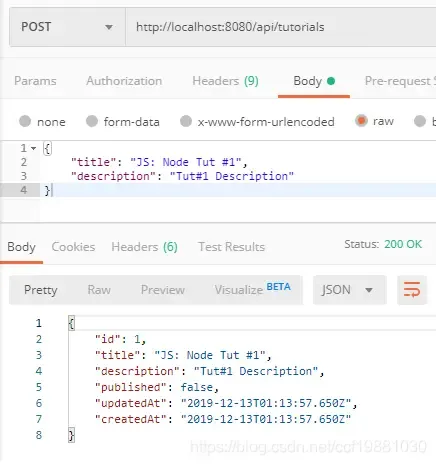
Create a new Tutorial
创建一些新教程后,您可以检查MySQL表:
mysql> select * from tutorials;
+----+-------------------+-------------------+-----------+---------------------+---------------------+
| id | title             | description       | published | createdAt           | updatedAt           |
+----+-------------------+-------------------+-----------+---------------------+---------------------+
|  1 | JS: Node Tut #1   | Tut#1 Description |         0 | 2019-12-13 01:13:57 | 2019-12-13 01:13:57 |
|  2 | JS: Node Tut #2   | Tut#2 Description |         0 | 2019-12-13 01:16:08 | 2019-12-13 01:16:08 |
|  3 | JS: Vue Tut #3    | Tut#3 Description |         0 | 2019-12-13 01:16:24 | 2019-12-13 01:16:24 |
|  4 | Vue Tut #4        | Tut#4 Description |         0 | 2019-12-13 01:16:48 | 2019-12-13 01:16:48 |
|  5 | Node & Vue Tut #5 | Tut#5 Description |         0 | 2019-12-13 01:16:58 | 2019-12-13 01:16:58 |
+----+-------------------+-------------------+-----------+---------------------+---------------------+
2、使用GET /tutorials Api检索所有的教程
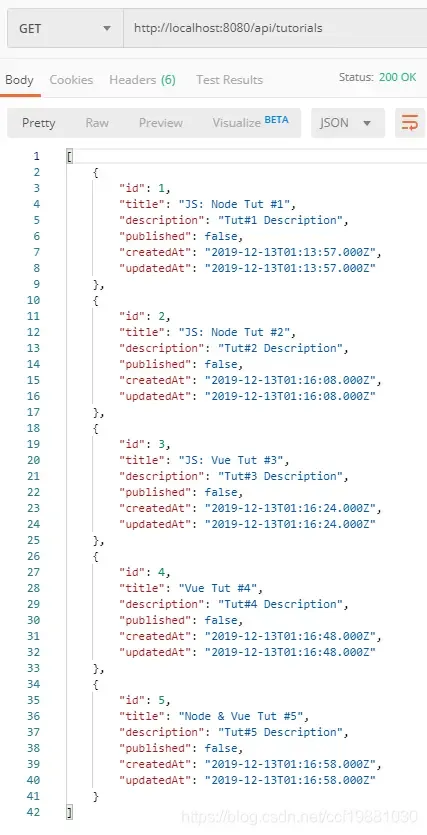
Retrieve all Tutorials
3、使用GET /tutorials/:id Api根据id查询单个教程
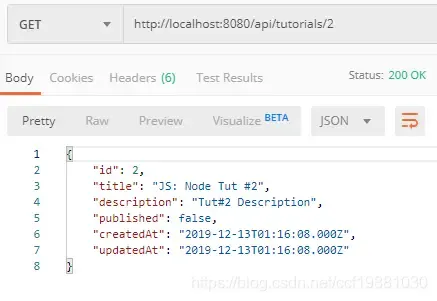
Retrieve a single Tutorial by id
4、使用`PUT /tutorials/:id’ Api更新教程
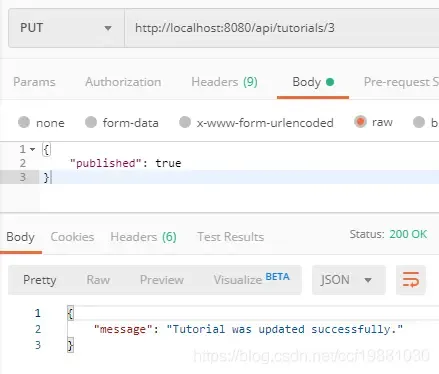
Update a Tutorial
在更新某些行后,请查看tutorials表:
mysql> select * from tutorials;
+----+-------------------+-------------------+-----------+---------------------+---------------------+
| id | title             | description       | published | createdAt           | updatedAt           |
+----+-------------------+-------------------+-----------+---------------------+---------------------+
|  1 | JS: Node Tut #1   | Tut#1 Description |         0 | 2019-12-13 01:13:57 | 2019-12-13 01:13:57 |
|  2 | JS: Node Tut #2   | Tut#2 Description |         0 | 2019-12-13 01:16:08 | 2019-12-13 01:16:08 |
|  3 | JS: Vue Tut #3    | Tut#3 Description |         1 | 2019-12-13 01:16:24 | 2019-12-13 01:22:51 |
|  4 | Vue Tut #4        | Tut#4 Description |         1 | 2019-12-13 01:16:48 | 2019-12-13 01:25:28 |
|  5 | Node & Vue Tut #5 | Tut#5 Description |         1 | 2019-12-13 01:16:58 | 2019-12-13 01:25:30 |
+----+-------------------+-------------------+-----------+---------------------+---------------------+
5、使用GET /tutorials?title=node查找标题包含’node’的所有教程
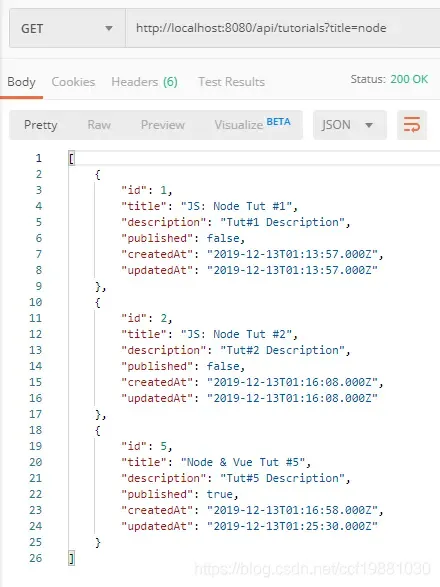
Find all Tutorials which title contains ‘node’
6、使用GET /tutorials/published Api查询所有已发布的教程
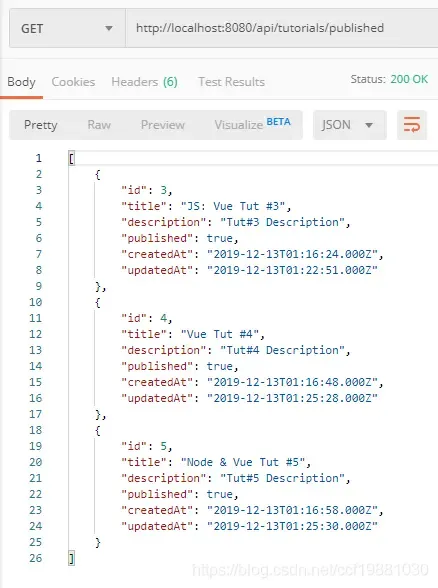
Find all published Tutorials
7、使用’DELETE /tutorials/:idApi删除一个教程  id = 2的教程已从tutorials`表中删除:
mysql> select * from tutorials;
+----+-------------------+-------------------+-----------+---------------------+---------------------+
| id | title             | description       | published | createdAt           | updatedAt           |
+----+-------------------+-------------------+-----------+---------------------+---------------------+
|  1 | JS: Node Tut #1   | Tut#1 Description |         0 | 2019-12-13 01:13:57 | 2019-12-13 01:13:57 |
|  3 | JS: Vue Tut #3    | Tut#3 Description |         1 | 2019-12-13 01:16:24 | 2019-12-13 01:22:51 |
|  4 | Vue Tut #4        | Tut#4 Description |         1 | 2019-12-13 01:16:48 | 2019-12-13 01:25:28 |
|  5 | Node & Vue Tut #5 | Tut#5 Description |         1 | 2019-12-13 01:16:58 | 2019-12-13 01:25:30 |
+----+-------------------+-------------------+-----------+---------------------+---------------------+
8、使用’DELETE /tutorialsApi删除所有的教程  现在在tutorials`表中没有一行数据了:
mysql> SELECT * FROM tutorials;
Empty set (0.00 sec)
结论
今天,我们已经学习了如何使用Express Web服务器创建Node.js Rest Apis。 我们还知道添加MySQL数据库和Sequelize配置,创建Sequelize模型,编写控制器以及定义用于处理所有CRUD操作的路由的方法。
您可以在下一个教程中找到更多有趣的东西:
- Server side Pagination in Node.js with Sequelize and MySQL
返回分页数据作为响应:
{
    "totalItems": 8,
    "tutorials": [...],
    "totalPages": 3,
    "currentPage": 1
}
- Deploying/Hosting Node.js app on Heroku with MySQL database
或者您可以将图像保存到MySQL数据库: - Upload/store images in MySQL using Node.js, Express & Multer
学习愉快! 再见。
进一步阅读
- Express.js Routing
- https://www.npmjs.com/package/express
- https://www.npmjs.com/package/body-parser
- https://www.npmjs.com/package/mysql2
- Tutorials and Guides for Sequelize v5
将教程数据从文件上传到MySQL数据库表:
– Node.js: Upload Excel file data into MySQL Database
– Node.js: Upload CSV file data into MySQL Database
源代码
您可以在Github上找到此示例的完整源代码。
如果要为每个教程添加评论。 它是一对多关联,有一个有关该关系的教程:Sequelize Associations: One-to-Many example – Node.js, MySQL
或者,您可以为每个教程添加标签,并将教程添加到标签(多对多关系):
Sequelize Many-to-Many Association example with Node.js & MySQL
文章均来自互联网如有不妥请联系作者删除QQ:314111741 地址:http://www.mqs.net/post/11231.html

添加新评论